Parker Bauer · 13 October 2026
The Evolution of Automated Tagging Systems and Their Effects on Discoverability Within Personal Knowledge Bases
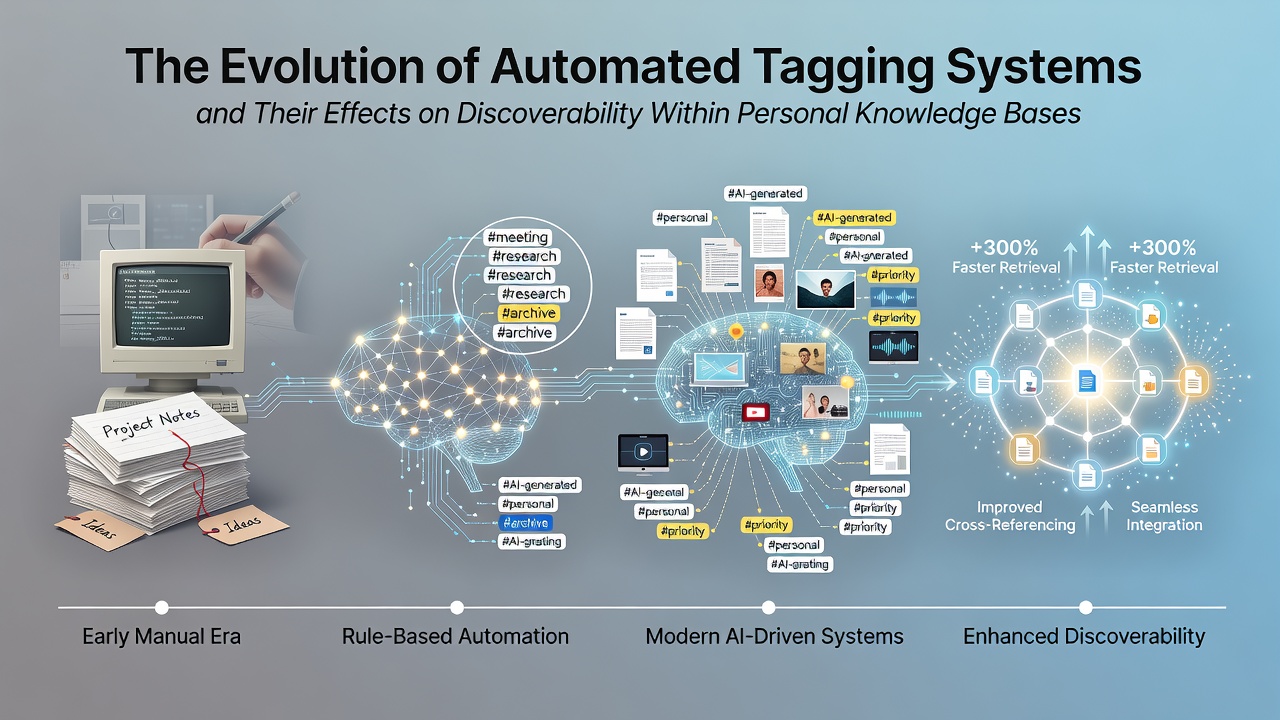
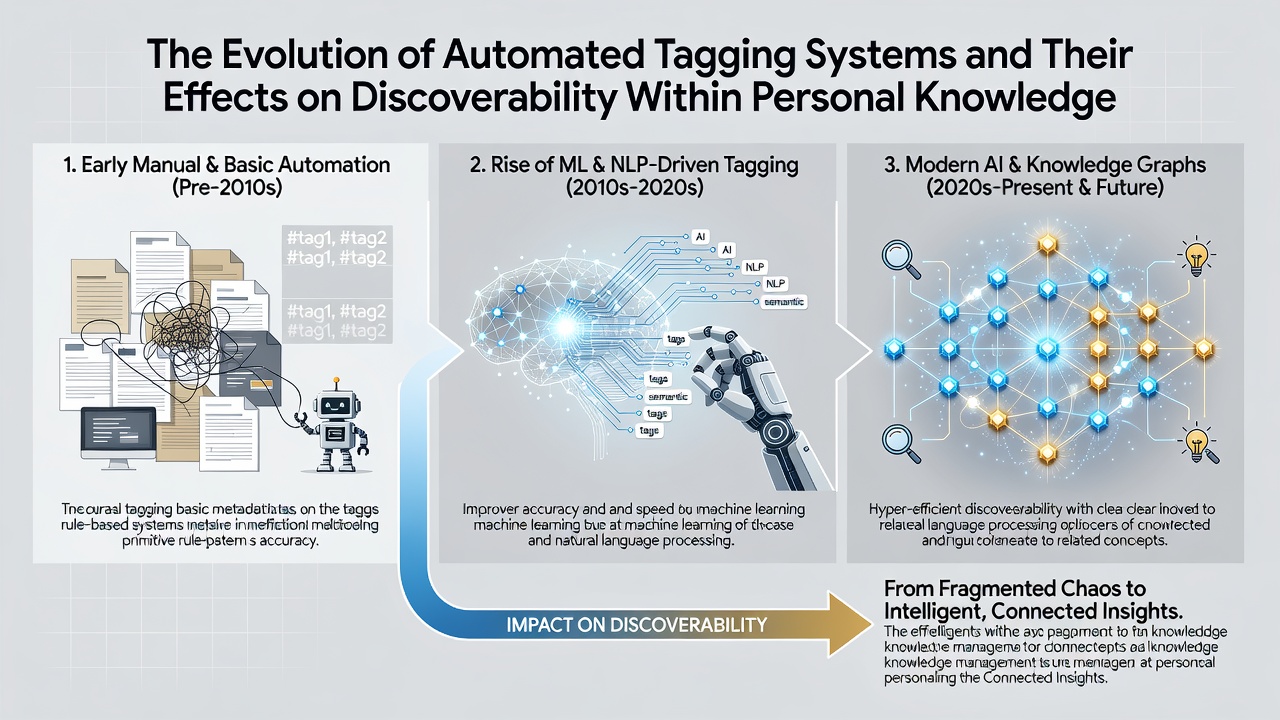
Personal knowledge bases have shifted from simple digital notebooks into complex repositories where automated tagging systems play a central role in organizing and surfacing information; researchers trace this development back to the early 2000s when users relied on manual tags in tools such as early versions of Evernote and personal wikis, and those initial approaches required individuals to assign keywords themselves which often led to inconsistent categorization across entries.
Early Manual Systems and Their Limitations
Manual tagging demanded consistent user effort yet produced variable results because people applied different terms to similar concepts while overlooking connections that later proved useful; studies from that period showed retrieval rates suffered when tag vocabularies diverged, and observers noted that discoverability remained tied to the memory of the original creator rather than any systematic structure.
Transition to Rule-Based Automation
By the mid-2010s rule-based automation began to supplement manual processes through scripts that scanned text for predefined keywords and applied tags accordingly; this method improved speed in large collections but still depended on human-defined rules that could not adapt to new terminology or emerging themes within a user's notes.
Machine learning models entered the picture around 2018 and changed the landscape by analyzing content patterns rather than matching fixed lists; these systems learned from existing tags and user corrections to suggest categories automatically, which expanded the range of discoverable connections without requiring exhaustive upfront configuration.
Impact of Machine Learning on Tagging Accuracy
Data from academic evaluations indicate that supervised learning techniques raised tag relevance scores by measurable margins compared with earlier rule sets, while unsupervised clustering revealed latent topics that users had not previously labeled; as a result, search functions in personal knowledge bases started returning entries that shared conceptual overlap even when surface keywords differed.
Effects on Discoverability Metrics
Discoverability within personal knowledge bases improved as automated tags enabled faceted search and recommendation engines that surfaced related notes during browsing sessions; quantitative reports compiled by research groups at institutions across North America and Europe show increased retrieval precision after the introduction of these features, particularly when tags incorporated contextual signals such as creation date and linked references.
Users who maintained extensive archives found that automated suggestions reduced the time spent locating information, and longitudinal observations confirm that cross-entry linkages grew denser once tagging became predictive rather than purely reactive; this density in turn supported serendipitous discovery where one note pointed toward another through shared automated categories.
Integration of Large Language Models by 2026
As of October 2026 many platforms have incorporated large language models that generate descriptive tags and summaries in a single pass, allowing personal knowledge bases to handle multilingual content and domain-specific jargon with greater consistency than previous generations; these models draw on vast training corpora yet fine-tune outputs to individual collections through continued user feedback loops.
Industry analyses from organizations such as the Association for Computing Machinery document how embedding-based tagging now captures semantic similarity across documents, which strengthens the ability of search algorithms to rank results according to conceptual proximity instead of exact term matches.
Current Challenges and Refinements
Privacy considerations have prompted developers to offer on-device processing options that keep tagging operations local, thereby limiting data exposure while maintaining performance gains; at the same time, bias mitigation techniques continue to evolve because training data can still influence which themes receive prominent tags in certain subject areas.
Interoperability standards emerging in recent years allow tags generated in one application to transfer into another without loss of meaning, and this development supports users who migrate between services or maintain multiple knowledge bases simultaneously; evidence from pilot programs indicates that standardized tag schemas further enhance discoverability across platform boundaries.
Conclusion
The progression from manual labeling to sophisticated automated systems has measurably altered how individuals locate and connect information inside personal knowledge bases, with each technological layer building upon the last to increase both precision and breadth of retrieval; ongoing refinements in October 2026 point toward continued integration of contextual understanding that will likely sustain these improvements in the years ahead.