Parker Bauer · 29 September 2026
Semantic Mapping Approaches for Connecting Related Entries Across Note Repositories in Research Environments
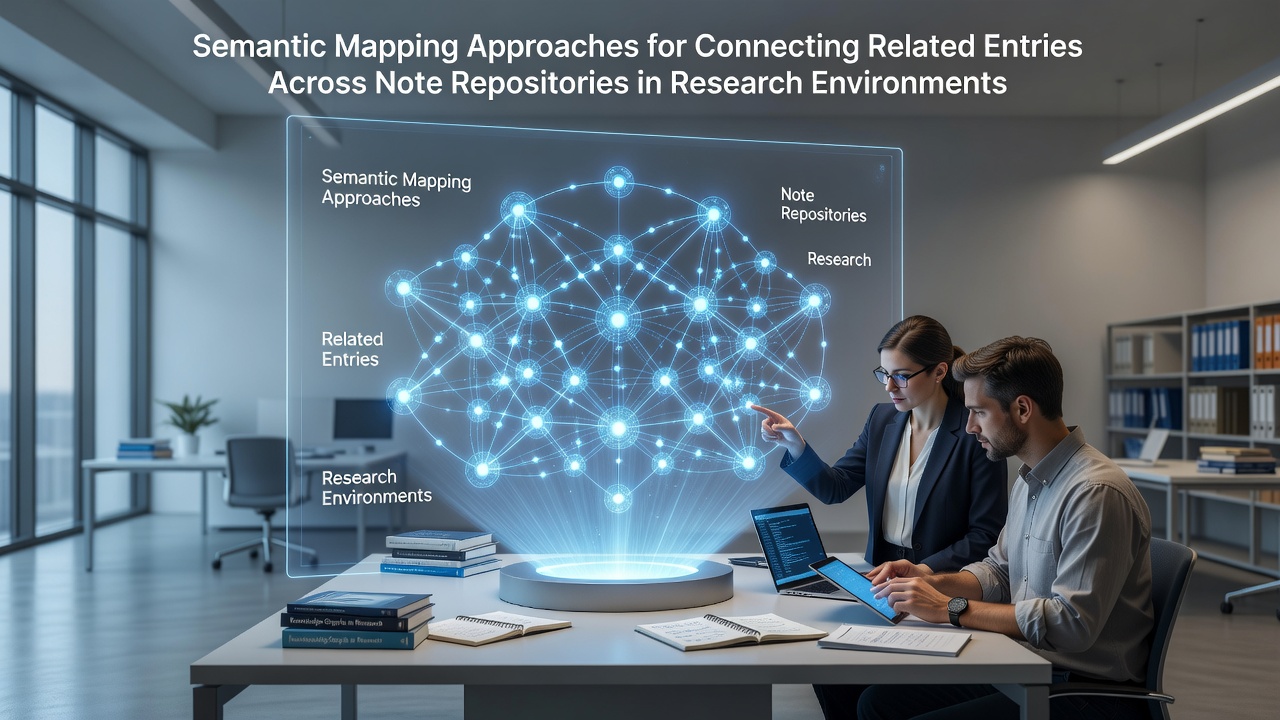
Researchers working across distributed note repositories often face the task of linking conceptually related entries that sit in separate systems, and semantic mapping provides structured methods to achieve those connections through meaning rather than exact string matches. These approaches rely on shared vocabularies, vector representations, and graph structures to identify relationships that would otherwise remain hidden in isolated collections of laboratory notes, literature summaries, and experimental logs.
Core Techniques Used in Semantic Mapping
One established technique centers on ontology alignment, where domain-specific vocabularies such as those developed for biomedical research receive formal mappings that allow notes tagged under different but equivalent terms to surface together during queries. Another method employs embedding models trained on large corpora of scientific text, so that vector proximity between note fragments indicates topical overlap even when surface wording diverges. Graph-based representations further extend these capabilities by modeling notes as nodes and inferred relationships as edges, enabling traversal algorithms to surface chains of related entries that span multiple repositories.
Data from collaborative projects shows that institutions adopting combined embedding and graph methods record measurable increases in the number of cross-repository links identified automatically. In September 2026 several research consortia plan to release updated alignment benchmarks that incorporate newer embedding architectures, allowing direct comparison of precision and recall across different note management platforms.
Integration Patterns Observed in Practice
Teams that maintain separate note systems for raw data capture and for interpretive discussion frequently apply semantic mapping at scheduled synchronization points, running alignment routines that update a central knowledge graph without forcing migration of the original notes. This pattern preserves local workflows while creating a unified view that researchers can query through a single interface. Observers note that repositories using standardized metadata schemas achieve higher mapping success rates because the additional context reduces ambiguity during embedding comparisons.
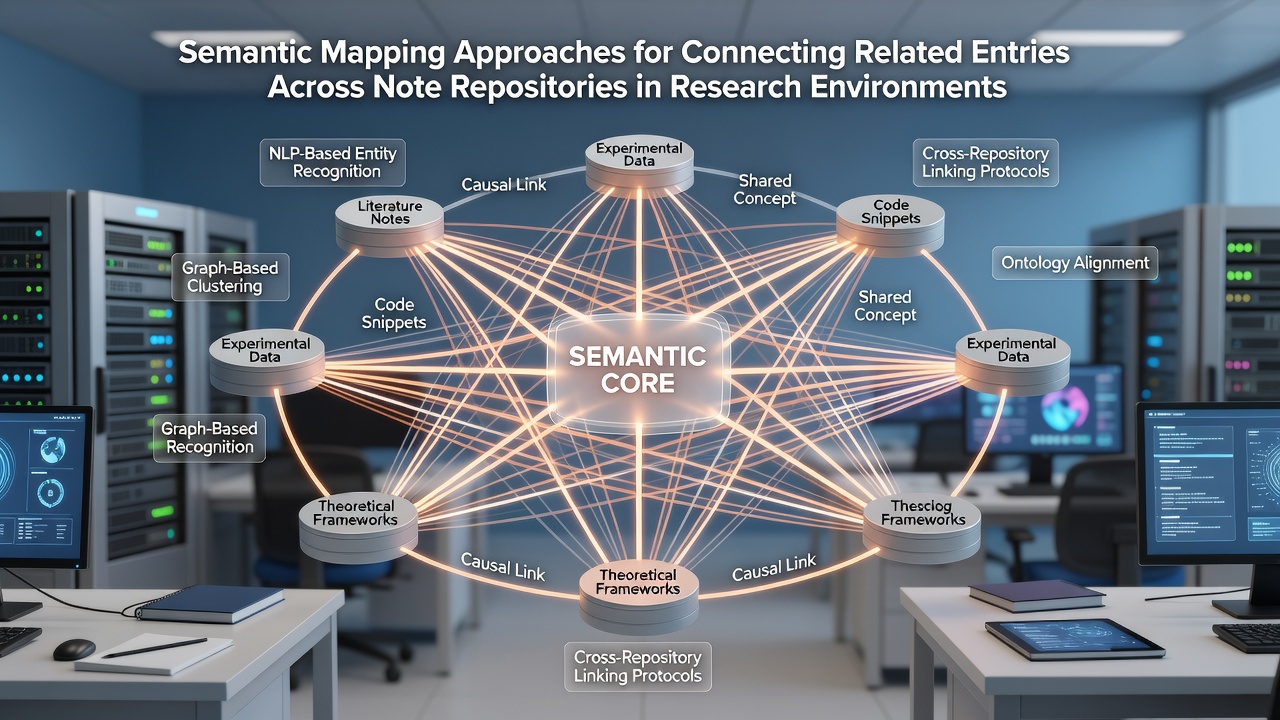
Case examples from multi-site clinical studies illustrate how semantic mapping surfaces connections between protocol deviation notes stored in one system and outcome measurements recorded in another. The resulting links help analysts trace how early observations influenced later interpretations without requiring manual cross-referencing of thousands of individual entries. Similar patterns appear in environmental science projects where field notes, sensor logs, and modeling outputs reside in distinct repositories yet share underlying concepts that mapping tools can surface.
Standards and Infrastructure Supporting Broader Adoption
International efforts to define common semantic frameworks have produced reference models that note repository developers can implement directly. According to documentation from the National Institutes of Health data sharing policies, consistent use of controlled vocabularies improves interoperability between systems funded under separate programs. Parallel work coordinated through the European Research Council emphasizes provenance tracking within mapped graphs, so that users retain visibility into the origin of each linked note even after alignment occurs. These infrastructure elements reduce the manual effort previously required to maintain cross-repository relationships over time.
Evaluation Metrics and Ongoing Refinement
Assessment of semantic mapping quality typically involves precision and recall measured against human-curated gold standards, alongside metrics that capture coverage across repository boundaries. Research groups refine their models by incorporating feedback from domain experts who review proposed links and flag incorrect alignments. This iterative process has led to incremental gains in accuracy as embedding techniques evolve and as larger annotated datasets become available for training. Figures from recent repository audits reveal that systems employing active learning loops, where user corrections feed back into the model, demonstrate faster convergence toward stable mapping performance than purely unsupervised approaches.
Conclusion
Semantic mapping approaches continue to expand the practical reach of note repositories by turning isolated collections into interconnected resources that support discovery across research domains. The combination of ontology alignment, embedding models, and graph structures provides multiple pathways for linking related entries while respecting the autonomy of individual systems. Continued alignment wth evolving standards and evaluation practices ensures these methods remain effective as note volumes grow and as new repository platforms enter use.